< Measuring and precision tools Squares and levels
Precision squares and levels: essential tools for the machine industry
In the world of machine shops, precision is a crucial element that determines the quality and reliability of finished products. Among the tools that guarantee such precision, precision squares and levels occupy a prominent place. These tools, although they may seem simple, are crucial in ensuring that each component is perfectly aligned and conforms to the required specifications.
The importance of precision squares
Precision squares are tools used to verify the right angle between two surfaces. They are essential in many applications, from the construction of complex machinery to the simple inspection of mechanical components. Their ability to guarantee a perfect 90-degree angle is crucial to avoid assembly errors that could compromise the functioning of an entire system.
Precision brackets are made from high quality materials, such as hardened steel, to ensure strength and durability. Their surface is often precision ground to ensure that there are no imperfections that could affect measurement. In addition, some squares are equipped with graduated scales to facilitate further measurements.
Precision spirit levels: ensuring horizontality and verticality
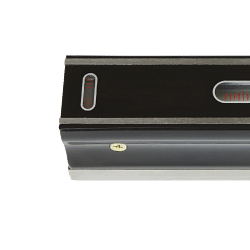
Precision spirit levels are instruments used to determine the horizontality or verticality of a surface. They are particularly useful in machine installation and maintenance operations, where it is essential that surfaces are perfectly level to ensure optimal operation.
Precision spirit levels are equipped with liquid-filled vials, inside which an air bubble moves to indicate the inclination of the surface. The sensitivity of the spirit level is determined by the curvature of the vial: a greater curvature indicates greater sensitivity. Precision spirit levels can be used in a variety of applications, from building construction to the calibration of industrial machinery.
Correct use of precision instruments
The correct use of precision squares and spirit levels is crucial for accurate results. Before using a precision square, it is important to ensure that it is clean and free of debris that could affect measurement. The square must be placed carefully on the surface to be measured, ensuring that it is in full contact with both surfaces.
For precision spirit levels, it is essential to place them on a stable, vibration-free surface. The bubble reading must be taken carefully, making sure that the spirit level is positioned correctly and that the bubble is centred between the reference lines.
Advantages of using precision instruments
The use of precision squares and spirit levels offers several advantages. Firstly, they ensure that mechanical components are assembled correctly, reducing the risk of failure and improving the reliability of the final product. In addition, the use of precision tools can reduce machining time, as they allow for quick and accurate measurements without the need for subsequent corrections.
Another significant benefit is the reduction of waste. Inaccurate measurements can lead to production errors that require replacement or repair of components, increasing costs and production time. Precision tools help minimise these errors, contributing to a more efficient and cost-effective production process.
Frequently asked questions about precision tools
1. What is the difference between a precision team and a joint team?
Precision squares are designed to guarantee a perfect right angle, with very small tolerances compared to ordinary squares. They are made of high-quality materials and often ground to ensure maximum precision.
2. How do I calibrate a precision spirit level?
Calibrating a precision spirit level can be done by placing it on a surface known to be perfectly horizontal or vertical and adjusting the vial until the bubble is centred. It is important to follow the manufacturer's instructions to ensure correct calibration.
3. What are the most common materials used for precision squares?
Precision brackets are commonly made of hardened steel, cast iron or aluminium, depending on specific strength and weight requirements.
4. Can precision levels be used outdoors?
Yes, precision levels can be used outdoors, but it is important to protect them from adverse weather conditions and to clean them thoroughly after use to avoid damage.
5. How often should precision instruments be calibrated?
The frequency of calibration depends on the use and environment in which the instruments are used. In general, it is advisable to calibrate precision instruments regularly to ensure accurate measurements.
In conclusion, precision squares and levels are indispensable tools in machine shops and many other industrial applications. Their ability to guarantee accurate and reliable measurements is crucial to the quality and efficiency of production processes. Investing in high-quality precision instruments and using them correctly can make the difference between a mediocre and an excellent product.
Read More Read Less