< Measuring and precision tools Digital dial gauges
An introduction to digital comparators for industry
In the context of mechanical workshops and manufacturing industries, accuracy and precision are fundamental to ensuring product quality and the efficiency of production processes. Digital comparators are an essential tool for achieving these objectives. These devices, also known as digital indicators, are used to measure small variations in dimensions or displacement, providing digital readings that are easy to interpret and highly precise.
What are digital comparators?
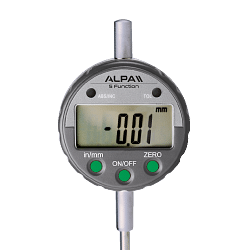
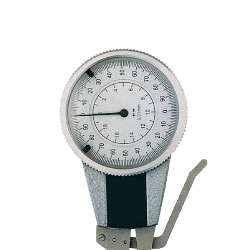
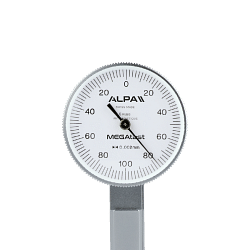
Digital comparators are measuring instruments that convert mechanical movement into an electronic signal, displaying the result on a digital display. Unlike analogue comparators, which use a dial with a pointer, digital comparators offer a direct and precise reading, reducing the margin for human error. They are commonly used in applications where high precision is required, such as in quality control and the calibration of machinery.
Use of digital comparators in mechanical workshops
In mechanical workshops, digital comparators are used for a variety of applications, including the measurement of dimensional tolerances, flatness checks and the verification of component alignment. Thanks to their ability to provide quick and accurate measurements, these instruments are indispensable for ensuring that manufactured parts meet design specifications. Furthermore, the ease of use of digital comparators allows operators to carry out frequent checks without significantly disrupting the workflow.
Advantages of digital comparators over traditional tools
Digital comparators offer numerous advantages over traditional measuring instruments. Firstly, the digital readout eliminates parallax error, which is common in analogue devices. Furthermore, many digital comparators are equipped with advanced features, such as the ability to store measurement data, transfer it to a computer for analysis, and set alarms for out-of-tolerance values. These features not only improve measurement accuracy but also enhance operational efficiency and data traceability.
How to choose the right digital comparator
Choosing the most suitable digital comparator depends on several factors, including the specific application, the required measurement range and the level of accuracy needed. It is also important to consider the device’s robustness, especially if it will be used in harsh industrial environments. Some models offer water and dust resistance, making them ideal for use in adverse conditions. Furthermore, compatibility with other measuring instruments and software can be a determining factor when choosing a digital comparator.
Maintenance and calibration of digital comparators
To ensure optimal performance and a long service life, it is essential to carry out regular maintenance and periodic calibration of digital comparators. Calibration must be carried out by qualified personnel using certified reference instruments. Furthermore, it is important to follow the manufacturer’s instructions for cleaning and storing the device, avoiding exposure to extreme conditions that could compromise its accuracy.
Technological innovations in digital comparators
In recent years, digital comparators have benefited from significant technological innovations. Integration with data management systems and the use of wireless technologies have greatly improved the ease of use and connectivity of these instruments. Furthermore, the adoption of advanced sensors has increased the accuracy and speed of measurements, making digital comparators even more reliable and versatile.
FAQs on digital comparators
What is a digital comparator?
A digital comparator is a measuring instrument that provides digital readings of small dimensional variations or displacements.
What are the advantages of digital comparators over analogue ones?
Digital comparators offer more accurate readings, eliminate parallax error and often include advanced features such as data storage.
How do you use a digital comparator?
A digital comparator is used by positioning its measuring stylus against the object to be measured and reading the value on the digital display.
Which industrial applications require the use of digital comparators?
They are used in quality control, machine calibration and the verification of dimensional tolerances.
How do you calibrate digital calipers?
Calibration must be carried out by qualified personnel using certified reference instruments.
What features should be considered when choosing a digital comparator?
Accuracy, measurement range, robustness, compatibility with other instruments and advanced features.
Can digital comparators be used in harsh environments?
Yes, many models are designed to withstand adverse conditions such as dust and humidity.
What is the difference between a digital comparator and a micrometer?
A digital comparator measures small variations in dimensions, whilst a micrometer measures absolute dimensions with high precision.
Can a digital comparator be connected to a computer?
Yes, many models offer the option to transfer data to a computer for analysis.
What recent innovations have improved digital comparators?
Integration with data management systems, the use of wireless technologies and advanced sensors have improved accuracy and connectivity.Read More Read Less