An introduction to industrial air coolers
In the context of mechanical workshops, operational efficiency and environmental comfort are crucial factors in ensuring productivity and safety. Industrial air coolers represent an advanced solution for temperature and humidity control, helping to create an optimal working environment. These devices are designed to address the specific challenges of industrial applications, offering effective and sustainable cooling.
Industrial air coolers use an evaporation process to lower the air temperature, utilising the ambient thermal energy. This method is not only environmentally friendly but also cost-effective, as it reduces energy consumption compared to traditional air-conditioning systems. In this article, we will explore in detail what industrial air coolers are, how they work, their advantages and their specific applications in engineering workshops.
How industrial air coolers work
Industrial coolers operate on the principle of water evaporation. Hot air is drawn through a wet filter, where the water evaporates, absorbing heat from the air and lowering its temperature. This process is known as evaporative cooling. Unlike traditional air conditioners, which use chemical refrigerants, industrial air coolers utilise a natural process, making them an eco-friendly and sustainable choice.
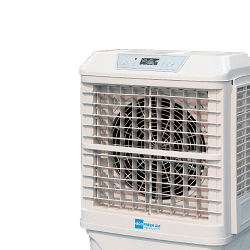
The system consists of a fan, a water tank and an evaporative filter. The fan draws in hot air through the filter, where the water evaporates, cooling the air. The cooled air is then distributed throughout the room, helping to maintain a comfortable and constant temperature.
Advantages of industrial air coolers in mechanical workshops
The use of industrial air coolers in mechanical workshops offers numerous advantages. Firstly, evaporative cooling is highly energy-efficient, significantly reducing operating costs. Furthermore, these units improve air quality by increasing humidity levels and reducing the presence of dust and airborne particles.
Another key advantage is the ease of installation and maintenance. Industrial coolers do not require complex ducting systems and can be easily integrated into existing spaces. Maintenance is straightforward and mainly involves cleaning the filters and refilling the water tank.
Furthermore, industrial air coolers are particularly well-suited to environments with large open spaces, such as engineering workshops, where air circulation is essential to ensure a safe and comfortable working environment.
Specific applications in mechanical workshops
Mechanical workshops present unique challenges in terms of temperature and air quality control. The use of heavy machinery and production processes generates heat, which can compromise workers’ comfort and safety. Industrial air coolers are ideal for tackling these challenges, providing effective cooling and improving air quality.
Furthermore, the increase in relative humidity helps to reduce the build-up of static electricity, a common problem in mechanical workshops that can damage sensitive electronic components. The use of industrial air coolers helps to maintain a safe and productive working environment, reducing the risk of breakdowns and improving operational efficiency.
How to choose the right industrial air cooler
Choosing the right industrial air cooler depends on several factors, including the size of the area to be cooled, the desired humidity level and specific operational requirements. It is important to consider the unit’s cooling capacity, expressed in cubic metres per hour (m³/h), to ensure it is suitable for the size of the space.
Furthermore, it is essential to assess the quality of the materials and the robustness of the design, as industrial air coolers must withstand demanding operating conditions. Ease of maintenance and the availability of spare parts are other important aspects to consider when choosing the most suitable unit.
Maintenance and care of industrial air coolers
Regular maintenance of industrial air coolers is essential to ensure their efficiency and longevity. Cleaning the filters is one of the most important maintenance tasks, as dirty filters can reduce cooling efficiency and compromise air quality.
It is advisable to check and clean the filters at least once a month, or more frequently in particularly dusty environments. Furthermore, the water tank must be regularly refilled and cleaned to prevent limescale build-up and the growth of bacteria.
Finally, it is important to periodically check the operation of the fan and other mechanical components to ensure the unit is functioning optimally.
Frequently asked questions about industrial air coolers
How do industrial air coolers work?
Industrial coolers operate using evaporative cooling, whereby hot air is drawn through a damp filter, cooling as the water evaporates.
What are the advantages of industrial air coolers compared to traditional air conditioners?
Industrial coolers are more energy-efficient, environmentally friendly and improve air quality by increasing humidity and reducing dust.
Are industrial air coolers suitable for all mechanical workshops?
Yes, they are particularly suitable for environments with large open spaces and where constant air exchange is required.
How much maintenance do industrial air coolers require?
They require regular maintenance, mainly cleaning the filters and topping up the water tank.
Can industrial air coolers reduce static electricity?
Yes, by increasing relative humidity, industrial air coolers can help reduce the build-up of static electricity.
What are the main components of an industrial air cooler?
The main components include a fan, a water tank and an evaporative filter.
How do you choose the right industrial air cooler?
The choice depends on the size of the area to be cooled, the cooling capacity and specific operational requirements.
Are industrial coolers environmentally friendly?
Yes, they use a natural evaporative cooling process, without chemical refrigerants, making them environmentally friendly.
What are the typical applications of industrial air coolers?
They are used in engineering workshops, warehouses, factories and other industrial environments to improve comfort and safety.
Can industrial air coolers be used indoors?
Yes, but it is important to ensure adequate air circulation to maximise cooling efficiency.Read More Read Less