< Clamping systems Driven tool holders
Motorised toolholders for lathes and CNCs represent a key element in advanced machining. These tools, designed to improve the efficiency and precision of turning and milling operations, have become indispensable in modern workshops aiming to optimise production processes. In this in-depth look, we will explore in detail what motorised tool holders are, how they work, their advantages and practical applications in machine shops.
Understanding motorised tool holders
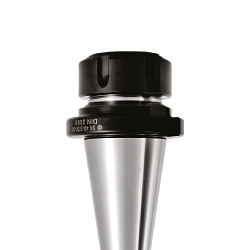
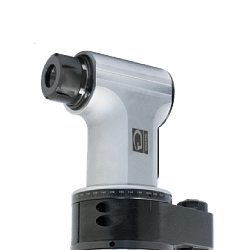
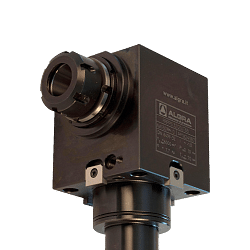
Motorised tool holders are devices that integrate a motor inside the tool holder itself, allowing the tool to rotate independently of the machine's main spindle. This feature allows milling, drilling and threading operations to be performed directly on the lathe or CNC machine, without the need to transfer the part to another machine. The ability to perform multiple machining operations in a single setup significantly reduces setup time and increases productivity.
Operation and use
The operation of motorised toolholders is based on a drive system that connects the motor to the tool. This system can be driven electrically or pneumatically, depending on the design and specifications of the machine. The operator can control the speed and direction of rotation of the tool through the control panel of the CNC machine, allowing great flexibility in machining operations.
The use of motorised tool holders is particularly advantageous in applications requiring complex, high-precision machining. For example, in the production of automotive or aerospace components, where precision and surface quality are critical, these tools allow excellent results to be achieved with fewer steps.
Advantages of motorised tool holders
The adoption of motorised tool holders offers numerous advantages to machine shops. Some of the main benefits include:
1. Reduced machining time: The ability to perform several operations without having to move the workpiece to different machines reduces the overall machining time.
2. Increased accuracy: Machining in a single setup minimises alignment errors and improves the dimensional accuracy of parts.
3. Operational flexibility: Motorised tool holders allow a wide range of operations to be performed, increasing the versatility of CNC machines.
4. Cost Savings: Reduced setup times and reduced scrap contribute to significant operating cost savings.
5. Improved product quality: The ability to perform complex machining operations with high precision results in higher quality finished products.
Practical applications in machine shops
In machine shops, motorised tool holders are used in a wide range of sectors. In the production of components for the automotive industry, for example, these tools are used for machining camshafts, gears and other critical components. In the aerospace industry, their precision and versatility are essential for the production of structural parts and engine components.
In addition, powered toolholders are widely used in the production of moulds and dies, where the complexity of shapes requires precise and detailed machining. The ability to perform milling and drilling operations directly on the lathe reduces production time and improves mould quality.
Answers to frequently asked questions
What are the requirements for the installation of motorised tool holders?
The installation of motorised tool holders requires a CNC compatible machine with an advanced control system capable of handling motorised operations. It is important to check that the machine can support the weight and size of the tool holder, as well as the power required for its operation.
How do you choose the right motorised tool holder for your application?
The choice of motorised tool holder depends on several factors, including the type of machining to be performed, the size of the workpiece, and the specifications of the CNC machine. It is advisable to consult an expert or the manufacturer to determine the most suitable model for your needs.
What maintenance is required for motorised tool holders?
Maintenance of motorised tool holders is essential to ensure their service life and efficiency. It is important to perform regular checks on the drive system, lubricate moving parts and check the integrity of electrical or pneumatic components. A preventive maintenance programme helps to avoid breakdowns and maintain high machine performance.
Conclusions
Motorised toolholders for lathes and CNCs represent an advanced solution for machine shops wishing to improve the efficiency and quality of their machining operations. Thanks to their ability to perform complex operations with precision and speed, these tools have become an indispensable element in modern production lines. Investing in motorised tool holders means not only optimising production processes, but also securing a competitive advantage in the global market.
Read More Read Less