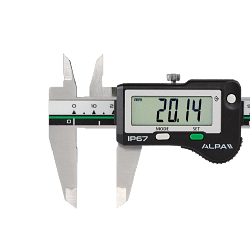
Digital calipers are among the most widely used measuring instruments in the technical and industrial fields, as they allow fast, readable and reliable dimensional checks on a wide range of components.
Thanks to their versatility, they are used in machine shops, quality control departments, industrial maintenance and all applications where external, internal, depth and step measurements need to be taken with immediacy and accuracy.
Compared to traditional models, digital calipers offer a very real operational advantage: the immediate reading of the value on the display. This reduces interpretation errors, speeds up dimensional checks and improves the repeatability of the inspection. For this reason, professional digital calipers are now an increasingly popular choice both in daily production activities and in processes where precision and reliability of the data are decisive elements.
The choice of the right instrument depends on several technical factors, including measuring range, resolution, accuracy, build quality and context of use. In many cases, those working in production or in the metrology room prefer precision digital calipers designed for smooth running, measurement stability and long life. In production and machining departments, digital calipers for the shop floor are also in great demand, designed to offer robustness, ease of use and reliability even in environments exposed to dust, oils or intensive use.
Among the most popular formats is the 150 mm digital calipers, considered by many to be the standard for general dimensional control, thanks to a good balance between practicality and measuring capacity. Depending on the application, however, instruments with a longer range or superior construction characteristics may be required. In all cases, choosing a professional digital calipers means investing in an instrument capable of improving control efficiency and overall process quality.
In the panorama of digital measuring instruments, gauges represent an indispensable solution for those looking for a quick but technically reliable control. For this reason, professional precision gauges remain one of the most popular tools for workshops, laboratories and manufacturing companies that want to combine ease of use, measurement accuracy and operational continuity.
Why choose professional digital calipers
Digital calipers are highly appreciated because they enable fast, intuitive and accurate dimensional inspection. The main advantages are
- immediate reading of the measured value
- reduction of interpretation errors
- fast control operations
- possibility of measuring externals, interiors, depths and steps
- good ease of use in production and on the shop floor
- availability of high-precision professional models
The quality of the result, however, depends on the class of the instrument, its correct use and its maintenance over time.
How to choose the right digital calipers
Choosing the right gauge depends not only on price or brand, but on a number of technical features that directly affect the reliability of the measurement.
Measuring range
It must be consistent with the dimensions of the components to be checked. The 150 mm digital calipers are the most common model for general use, but for larger parts, 200 or 300 mm instruments may be required.
Resolution
Indicates the smallest increment readable on the display. In professional models it is often 0.01 mm.
Accuracy
This is one of the most important parameters, as it determines how close the measured value is to the actual value.
Build quality
Materials, finish of the measuring surfaces, sliding stability and overall robustness affect the accuracy and durability of the instrument.
Operating environment
In the presence of oils, liquids or dust, it is better to opt for models more suitable for industrial use.
Frequency of use
For continuous use in production, it is preferable to choose professional digital calipers designed for constant reliability and long life.
Digital calipers FAQ
1. What are digital calipers?
Digital calipers are electronic measuring instruments used to measure external, internal, depth and step dimensions. Thanks to the display, they allow an immediate reading of the measured value and make dimensional inspection quicker and easier.
2. What is the difference between digital calipers and analogue gauges?
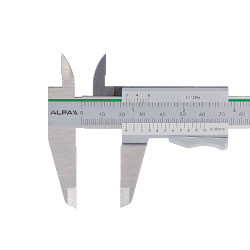
The main difference is in the reading of the measurement. Digital calipers show the value directly on the display, whereas analogue calipers require reading the vernier or graduated scale. The digital gauge is generally more immediate and practical, especially when frequent or repetitive checks have to be made.
3. When should professional digital calipers be chosen?
Professional digital calipers are recommended when you need constant accuracy, reliability over time and frequent use. They are particularly suitable for workshops, quality departments, technical laboratories and production environments where measurement is an essential step in the process.
4. Are digital calipers for the workshop suitable for everyday use?
Yes, digital calipers for the workshop are designed specifically for quick and repeated checks on mechanical components, thicknesses, diameters and dimensional dimensions. In harsh environments, it is important to choose robust, well-built models that can withstand dirt, oil and continuous use.
5. How accurate is a digital caliper?
Accuracy depends on the quality of the instrument, its measuring range and its stated accuracy. In professional models, the resolution is often 0.01 mm, but the actual quality of the measurement also depends on correct handling, surface cleanliness and the condition of the instrument.
6. What can be measured with a digital caliper?
With a digital caliper, you can measure outside diameters, inside diameters, depths, steps and thicknesses. This versatility makes it one of the most widely used digital measuring instruments in the mechanical, industrial and technical fields.
7. Why is the 150 mm digital caliper the most popular model?
The 150 mm digital caliper is considered the standard format because it offers a good balance between compactness, manageability and measuring capacity. It is suitable for most general dimensional checks on the shop floor and in quality control.
8. Why can a digital caliper give unreliable measurements?
The most common causes are dirt on the contact surfaces, wear and tear, shocks, low battery, incorrect use or failure to check periodically. Misalignment on the workpiece or excessive pressure can also adversely affect the result.
9. Do digital calipers require maintenance or calibration?
Yes, to maintain reliable measurements it is important to keep the measuring surfaces clean, store the instrument correctly and check its accuracy periodically. In professional environments, calibration is essential to maintain metrological control.
10. Is it worth choosing professional precision gauges over cheap models?
Yes, especially when the measurement affects product quality, component conformity or process repeatability. Professional precision gauges generally offer better build quality, greater measurement stability, smoother running and superior long-term reliability.
Digital calipers applications
Digital calipers are used in a variety of operating contexts, including:
- machine shops
- quality control departments
- industrial maintenance
- precision machining
- dimensional checks in production
- inspection of metal, plastic and technical components
Thanks to their versatility, digital calipers are an effective solution for those who need a fast, readable and reliable measuring instrument.
Read More Read Less