< Furnishings and storage Workbenches
An introduction to workbenches for mechanical workshops
At the heart of every mechanical workshop, workbenches are a fundamental element in ensuring efficiency and precision. These tools are not simply surfaces on which to work, but true allies in the production and maintenance of mechanical components. In this article, we will explore in detail what workbenches are, what they are used for, how they are used and what benefits they offer. We will also answer the most frequently asked questions to provide a comprehensive overview of this indispensable tool.
What are workbenches?
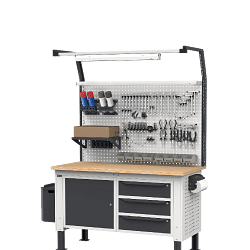
Workbenches are structures designed to provide a stable and sturdy surface on which to carry out assembly, repair and maintenance work. Made from robust materials such as steel, wood or aluminium, these workbenches are designed to withstand heavy loads and demanding working conditions. Their design can vary considerably, incorporating drawers, shelves and tool holders to suit the specific needs of each workshop.
What are workbenches used for?
Workbenches serve as multifunctional platforms for a wide range of mechanical tasks. They provide a solid base for assembling components, repairing machinery and building prototypes. Furthermore, thanks to their modular design, they can be customised with accessories such as vices, electrical sockets and integrated lighting, further enhancing productivity and operator safety.
How are workbenches used?
The use of workbenches varies depending on the tasks to be carried out. For assembling components, it is essential to have a clean and well-organised work surface, with all the necessary tools within easy reach. During repair work, the stability of the workbench is crucial to ensuring precision and safety. It is important to adjust the height of the workbench to suit the operator’s ergonomics, to prevent fatigue and injuries.
Benefits of workbenches in mechanical workshops
Using high-quality workbenches offers numerous advantages. Firstly, they improve operational efficiency, enabling operators to work more quickly and in a more organised manner. The workbench’s sturdiness and stability reduce the risk of errors and damage to components. Furthermore, the ability to customise the workbench with specific accessories increases its versatility and adaptability to different production requirements.
FAQs on workbenches
Which materials are best suited for workbenches?
The most common materials are steel, wood and aluminium, chosen based on their strength and the type of work to be carried out.
How can I customise a workbench?
You can add drawers, shelves, clamps, electrical sockets and lighting to adapt it to your needs.
What is the ideal height for a workbench?
The ideal height varies depending on the user’s ergonomics, generally between 90 and 110 cm.
Are workbenches suitable for outdoor use?
Some models are designed to withstand the elements, but it is advisable to use them indoors.
How do you keep a workbench in good condition?
It is important to clean it regularly, lubricate the moving parts and check that the structure is in good condition.
What accessories are essential for a workbench?
Accessories such as clamps, power sockets and lighting are essential for improving functionality.
Can workbenches support heavy loads?
Yes, high-quality workbenches are designed to support heavy loads, but it is important to check the manufacturer’s specifications.
Can a workbench be moved easily?
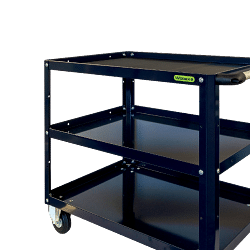
Some models are fitted with castors to make moving them easier, but stability must be ensured whilst in use.
What are the standard dimensions of a workbench?
Dimensions vary, but they are usually around 150–200 cm in length and 60–80 cm in width.
How do I choose the right workbench for my workshop?
Consider the size of the available space, the type of work you’ll be doing and the accessories you’ll need for your tasks.Read More Read Less